The hybrid publishing model ensures that you will retain 100% of your publishing rights, which in our mind is the single greatest asset you can retain. You will also have controlling input into your book editing, book and cover design, marketing, and of course, the creative direction of your book.
A structural edit is the most comprehensive editorial process, above which the only process is ghost-writing, idea inception, or our book writing strategies and packages. A structural edit does not involve checking for punctuation, spelling, or grammar, as this falls within the scope of the copy editor’s role. The structural edit’s consideration is to the actual sequence of sentences, phrases, and paragraphs, as well as the logical flow that makes up the manuscript as a whole. Think big picture of the manuscript.
It is very important to note that the structural editing process is not about changing your voice or rewriting your manuscript; instead, it will ensure that you receive constructive feedback with recommendations for improvement to your manuscript. This process assists with correcting and improving your work so as to best reach your target reader.
In some cases, your editor will be providing rewording of sentences or suggesting paragraph and chapter reconstruction or rewording. This includes the removal of repetition to ensure your manuscript is in the best structural position to proceed with the book editing process.
The structural editing process can take up to 8 weeks to complete, though this is dependent on each book. Your publisher will alert you to the expected date of completion early in the process.
Copy editing, or line editing, is the romanticised idea of editing, through which an editor will review typographical and grammatical errors; however, interestingly, they are not the primary focus of this edit. Your editor will make suggested changes to sentence structure, clarity, sense, and flow to ensure that your manuscript has clarity and flow of message and narrative. Your editor will check the content for reader comprehension as well as producing checks for genre-specific tone, language, and terminology. Your copy editor will also ensure your chapter arrangement is logical, that the length is appropriate for the genre, and that the overall length of the book is on target.
Please note that we suggest the copy editing process is a necessity to ensure your publication can meet industry standards and have the best chance of success in the world.
The copy editing process can take up to 4 weeks to complete, though this is dependent on each book. Your publisher will alert you to the expected date of completion early in the process.
The proofread is the last type of editing service that we provide, and please note that it should be used only as a last check. Your proofreader will focus only on spelling, typographical, and grammatical concerns. If your manuscript has been through the full book editing process, your proofread should be a very quick process indeed.
Your proofreader will review the manuscript for inconsistencies such as instances of unclear or weak phrasing, awkward repetitions, and will also be thoroughly reviewing your manuscript to find and address any subject-verb agreement problems, incorrect word choices, improper punctuation usage, as well as spelling, typographical, and grammatical concerns. Additionally, as we tend to provide the proofreading service as part of the typesetting and design stage, your proofread will also check for light formatting errors. Your proofreader will also ensure the document adheres to the chosen style guide, which you would have discussed with your publisher at the beginning of the editing process.
The proofreading process can take up to 4 weeks to complete, though this is dependent on each book. Your publisher will alert you to the expected date of completion early in the process.
This process involves our team registering your book title and blurb, as well as the retail price, genre, and book size, to your unique ISBN. This stands for International Standard Book Number, and as part of our service, we will organise both the paperback or the hardcover ISBN as well as your eBook ISBN.
From there, we will generate your unique barcode, which we can later place on your book cover design. We will also organise the pre-publication data with the National Library, and by doing so, are then responsible for the legal deposits to the National and State Libraries. This means that we do all the paper-pushing for you. Phew!
To help us complete the process for you, your publisher will send you a form to complete. This form will include all the necessary information for us to lock in your unique ISBN. Please don’t be worried if you haven’t finalised your title or are unsure of the price or other details, as we can help you.
The entire process of registering your unique ISBN and the cataloguing of publication data, as well as the generation of your unique barcode, can take up to five hours of administration to complete.
We say that we don’t judge a book by its cover, but we do. And you know you do! In fact, it’s more often than not the first thing that we see, and the first thing that draws our attention is the cover design. What attracts our eye and helps us make that decision to pick up the book is the book cover imagery and how it speaks to us. As such, during your publishing process, we need to explore your book cover idea and ensure that it is effective, relevant, and most of all, eye-catching.
A very common thread in the field of design for commercial needs is to keep it simple. You know that saying ‘Keep it Simple, Silly’. This is because many consumers do not have time to understand hidden meanings or contemplate intricate elements. They will, instead, simply move to the next book or, worse, not even see your cover on the shelf.
In keeping it simple, the fonts that are chosen, both for your book interior and cover design, are incredibly important. Your publisher will chose fonts that are simple and easy to read, and convey your and your book’s personality and messaging as well. As such, your publisher might choose to show you a number of different fonts, though we maintain that whatever you choose should be consistent across all portions of your author platform.
Our cover design process involves the development of a design brief with your publisher. It is critical for the outline of style, images, fonts, and colours to be included. In many cases, our team will make the design based on the brief produced by you and your publisher, however, if there are specific materials that you would like to use, please let us know and we can ensure that they are included.
Our team will be able to work these elements into the design, or, if you have no idea, your publisher can direct the team from a blank canvas—but of course, a little bit of information goes a long way. From there, we will produce two previews of your potential cover before we move to the full design.
We do have a set number of amendments we can make to the cover design, which can include sampling different fonts and images as well as shuffling their placements. These small changes do take time, so we allow up to two hours of amendments.
Aside from the design of your book cover, the format and typesetting of your book can be a very exciting process. What you might not know is that the book format and typesetting process is actually the result of very careful planning and attention to detail. Our book design team will work hard behind the scenes to make sure we have the proper styles, spacing, and fonts that match the theme of your book, your personality, and your message. Of course, your publisher will work with you to ensure we have chosen the right book dimensions for your market and your word count as well. It can be a very delicate balance.
When the full format of your book is complete, your publisher will review the design, focusing on the elements that you or the reader would be unlikely to consider or even notice. It is highly likely that there will even be rounds of amendments prior to you receiving the file for your author review.
Once the file is sent for your review, you will also be sent an amendments form to make note of any changes relevant to the overall look and feel of the book. Your amendments should only focus on formatting issues, stylisation of fonts, and other design elements. Please note that any major changes in font, book size, or spacing will be seen as outside the amendments process. Additionally, your publisher will discuss with you that no serious editorial changes should be made at this stage.
Clarity of communication is very important between you and your publisher during the design process. While you might not know the industry expected standards for format and typesetting of a book, your team is well versed in these.
The format and typesetting process can be quite succinct, with the preview taking roughly 1 week, and the full design taking up to 3 weeks to complete. Any amendments will have another 1 week of turnaround time. Once finished, your book will be ready for one last round of proofreading before we head into production!
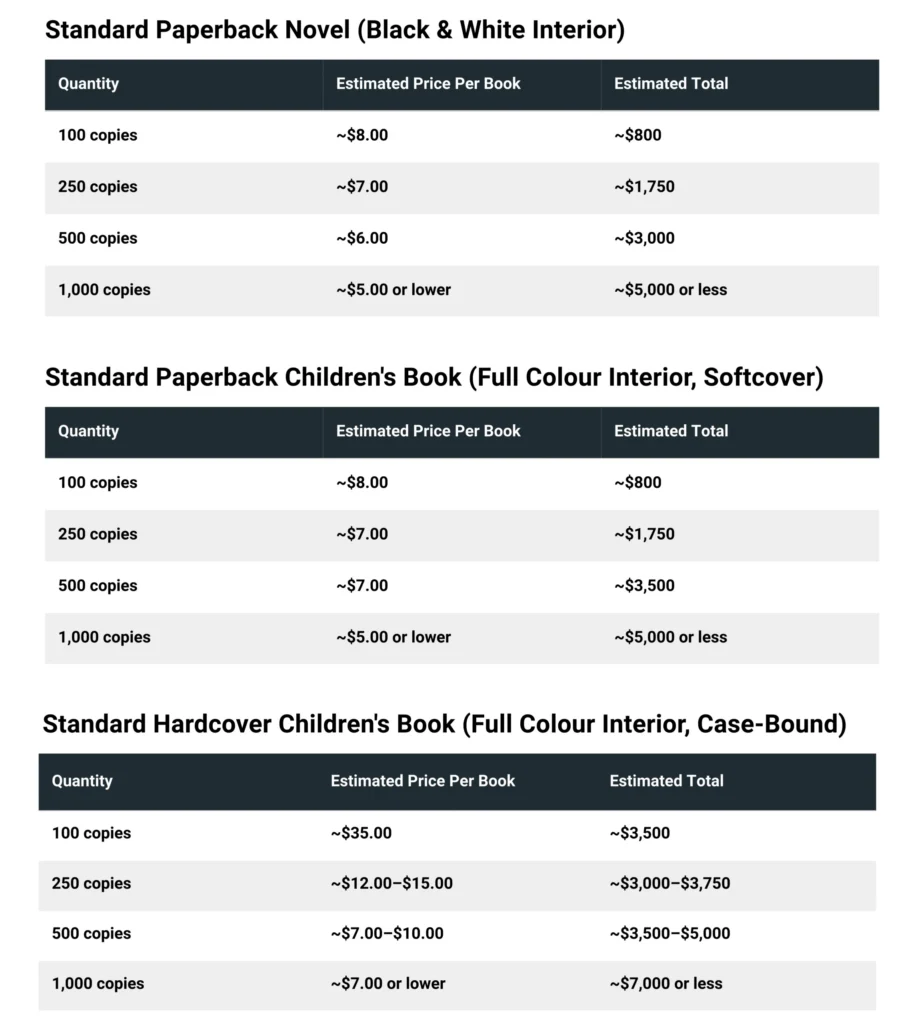
Now that your book cover design and book format are complete, we are ready for the printing process! Depending on the size of the print run you are wanting to produce, there are three types of printing that we employ. Your publisher will discuss the options with you based on your budget and book printing quantity, as well as your marketing strategy and whether we are printing paperback or hardcover.
The first type of printing is for very low quantities and is known as print on demand (POD). With our POD system, we can print as few as one book at a time. It is a very low cost option for authors wanting to break into the market and does come with some interesting positives and negatives. For example, there are limitations on the sizes and types of paper stock that we can choose from. And the price is relatively set, meaning there are no economies of scale when printing larger quantities. There are, however, lots of positives to this system as well. If you have sales offshore, this book printing option will allow you to print in the country of the order, and then ship the book locally, rather than having to ship it all the way around the world. This can save you on shipping!
From there, the next type of printing is digital printing. This type of production is really the mainstay of our book printing facility, as most of our orders are produced in this fashion. We work from our book printing facility in Brisbane, Australia, where the whole process is managed locally. Digital production is highly economical for authors looking to produce mid-range quantities of books. This would be in the range of 50 up to 1,000 books. There are minor limitations to this process, especially when looking at producing hardcover books and books that have lots of colour pages. The major positive with this type of book printing process is the short lead time, as we are able to produce books within roughly two weeks from approval.
Lastly, offset book printing is the printing process we employ when looking to produce more than 1,000 books or books with lots of colour pages, and hardcover books as well. Offset book production is employed in what we call economies of scale. This means that the price per unit drops dramatically when printing in large quantities. While we always strive to keep our book production within our local facility, our primary focus is to ensure you are making a return on your investment. As such, we have book printing partners in Malaysia, India, Singapore, and Hong Kong that we have worked with for many years.
As you move through the book publishing process, your publisher will discuss the different options with you and confirm the print costs in line with the initial quote that you were given at the start of your book publishing journey. The final price will be dependent on a number of factors that include the book’s size and number of pages, as well as the paper stock, book cover finish, and the type of binding.
To begin your book printing process, we will first produce a proof copy. This is called a galley proof, and is normally a loose-leaf copy of the book produced on the same paper and the same press for you to review before we proceed. At this stage, it is important to confirm that you are happy with the paper stock, the colours, and of course, the size of your book. Your publisher will work with you to ensure you are happy to approve and proceed and will oversee any changes that you might want to make. The proofing stage is very important as a last-minute check of the book before we proceed to print. So be sure to check everything very thoroughly!
From there, and once you have approved the proof copy, your publisher will press the big green print button! In terms of timeline, proof copies, regardless of which book printing method they have been produced through, will take approximately 2 weeks to be printed, checked, and sent to you. Once approved, you can expect:
Support: Light Best for: DIY & Budget Savvy
$990
2 Weeks
Included
Popular
$2,290
5 Months
Included
Popular
$3,490
12 Months
Included
Popular
Application only
Time Frame Varies
Included
To Suit your Budget
The Clark & Mackay Publishing Process

